Professional Audio Product Development: Understanding Engineering and Manufacturing Challenges
Written by Ted Chong, Senior Director, Product Development
Developing professional audio products for different users is challenging because each headset model must meet distinct requirements for comfort, audio performance, durability, and connectivity. The key is to align industrial design, acoustic engineering, electronics development, and manufacturing from the early concept stage, while deciding which elements can be shared across the product range and which require customization. This approach helps brands reduce redesign risks, improve development efficiency, and build scalable professional headset product families.
Professional audio products are often perceived as variations of the same headset platform. In reality, developing a professional headset product family for different users such as broadcast professionals, intercom operators, field technicians, production crews, and control-room personnel presents significant engineering and manufacturing challenges.
While products within a series may share a common design language, each user group brings different expectations for comfort, durability, audio performance, controls, connectivity, and environmental robustness. For audio brands, the challenge in professional audio development is to balance these user-specific needs with product customization and platform commonality, while keeping development efficient across the product range.
What Makes Professional Audio Product Development Challenging?
One of the biggest challenges in developing a professional audio product family is deciding what should remain common across all models and what should be customized.
For example, a headset designed for a broadcast director working in a control room may prioritize all-day wearing comfort, speech intelligibility, and lightweight construction. In contrast, a product intended for field production or industrial communication may require higher mechanical durability, enhanced environmental protection, replaceable components, and support for different communication interfaces. These differences show how the intended application can shape both product design and engineering requirements.
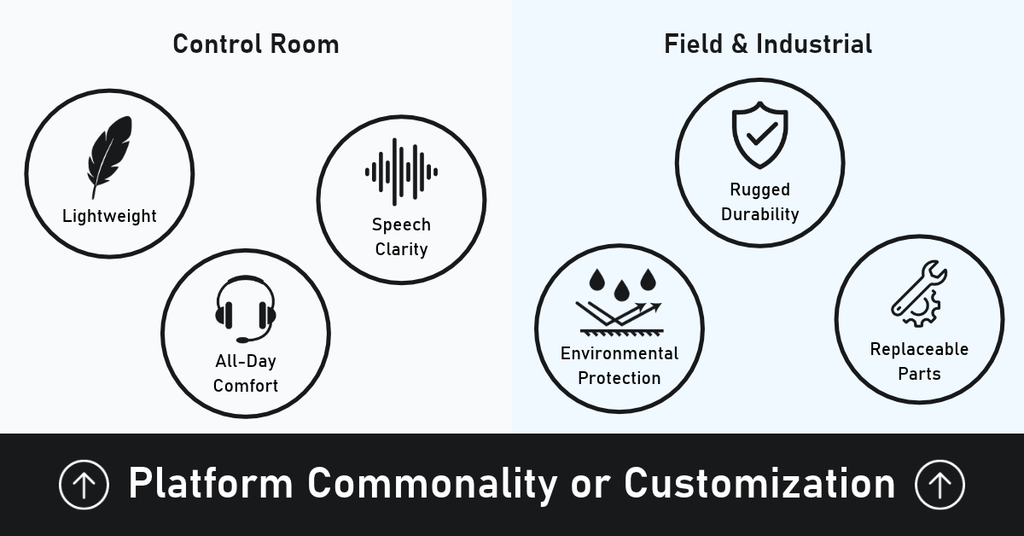
- As product tiers evolve, requirements often diverge in several key areas:
- Acoustic performance and microphone quality
- Wireless versus wired connectivity options
- User controls and interface complexity
- Battery life and power management
- Durability and environmental protection
- Weight and long-term wearing comfort
The challenge for brands is determining where platform commonality creates efficiencies and where customization is necessary to deliver the intended user experience. Decisions made early in architecture planning can significantly influence both development cost and future scalability.
Why Should Industrial Design and Electronics Development Start Together?
One common misconception is that industrial design can be finalized before electronics development begins. In reality, these disciplines are highly interconnected. Many industrial design decisions directly affect electronics performance and manufacturability, including:
- Internal volume allocation for batteries and PCBs
- Antenna placement and wireless performance
- Microphone positioning and acoustic paths
- Thermal management
- Serviceability and assembly methods
- Cable routing and strain relief
When electronic constraints are not considered early, development teams often encounter challenges later in the program that require expensive redesigns or compromises.
Successful projects typically involve close collaboration between industrial designers, electronics engineers, acoustic engineers, and manufacturing teams from the earliest concept stage. Early alignment helps avoid technical conflicts and reduces development risk.
What Makes Electronics Integration in Professional Headsets Complex?
Modern professional headsets contain far more electronics than previous generations. Wireless connectivity, digital audio processing, active noise management, battery systems, sensors, and advanced user controls must all coexist within a compact and ergonomic form factor.
Integrating these technologies into structures such as earcups and headbands introduces a range of challenges:
• Limited mechanical space
• RF and electromagnetic compatibility considerations
• Battery safety requirements
• Acoustic performance interactions
• Cable management and flex life requirements
• Structural durability and reliability
Even seemingly small electronic changes can trigger broad impacts across the product.
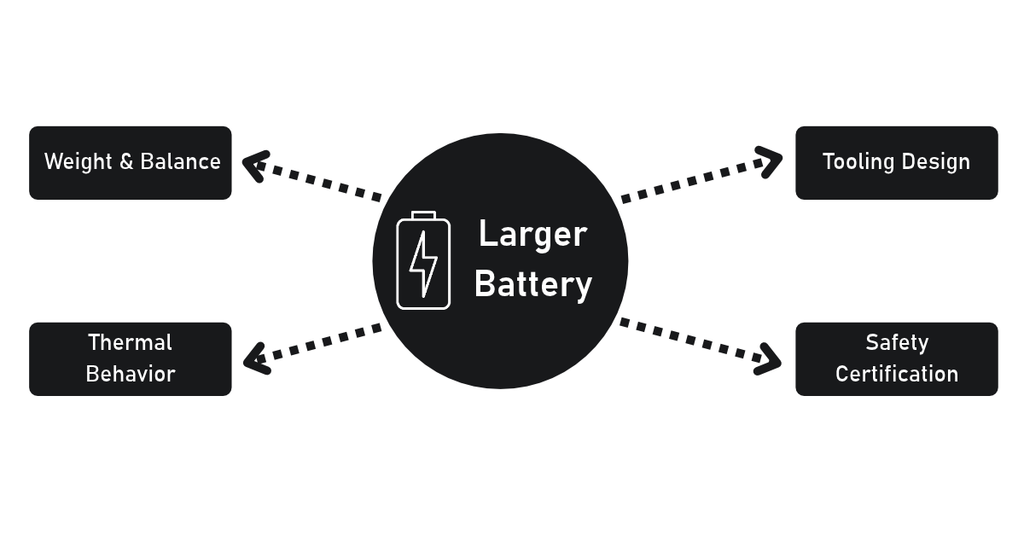
For example, increasing battery capacity may improve operating time but also affect product weight, balance, thermal behavior, tooling design, certification requirements, and assembly processes. A new wireless architecture may require changes to antenna placement, plastic material selection, internal layouts, and mechanical structures.
These interactions highlight why system-level engineering is essential throughout development.
How Do Engineered Soft Goods Affect Professional Audio Manufacturing?
Many of the manufacturing challenges associated with professional audio products originate during the product design phase rather than on the production line.
Integrating engineered soft goods with electronic assemblies creates particular complexity. Ear cushions, headbands, covers, and wearable surfaces must satisfy both user comfort and manufacturing requirements while accommodating electronics, wiring, and structural components. Challenges frequently include:
- Material compatibility
- Tolerance stack-up management
- Repeated flex and fatigue performance
- Assembly accessibility
- Cosmetic consistency
- Long-term durability under intensive daily use
The earlier these factors are considered, the easier it becomes to avoid costly tooling revisions, production inefficiencies, or field reliability concerns later in the project lifecycle.
How Does Cross-Functional Collaboration Reduce Product Development Risks?
One recurring lesson across many development programs is that successful products are rarely the result of optimizing a single discipline.
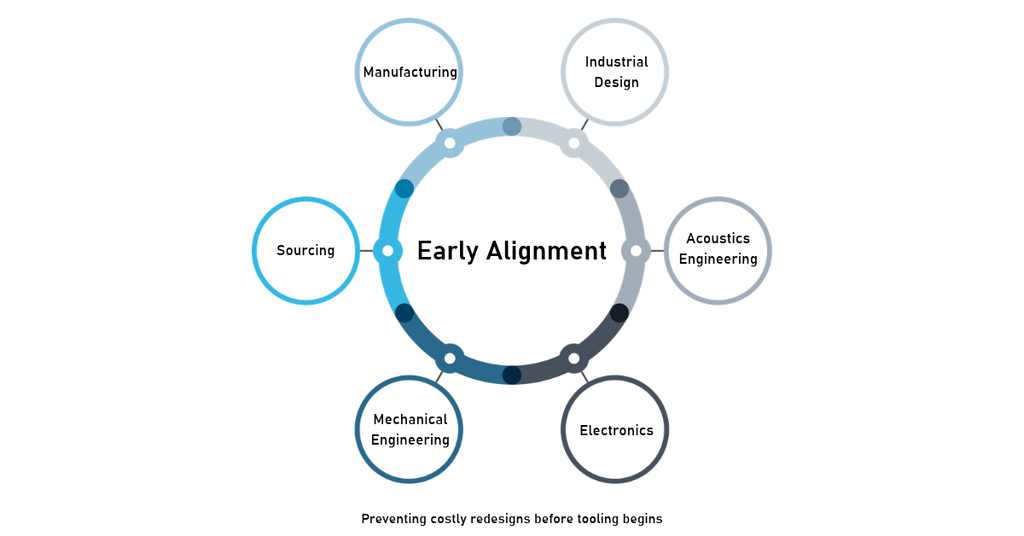
The most effective solutions emerge when industrial design, acoustic engineering, electronics development, mechanical engineering, sourcing, and manufacturing teams work together as an integrated system.
We have seen numerous projects where identifying integration risks early, whether related to antenna performance, cable routing, battery placement, or material selection, prevented significant redesign effort later in development. In many cases, challenges that appeared to be electronic issues were ultimately solved through mechanical design changes, while manufacturing insights helped improve both reliability and user experience.
This collaborative approach is particularly important when brands aim to develop multiple product configurations from a common platform. Success depends not only on strong individual engineering disciplines, but also on the ability to integrate them effectively.
How Can an Advanced Audio ODM Support Professional Audio Product Development?
At OSM, our experience combines electronics development with engineered soft goods expertise, enabling us to address challenges that span multiple engineering domains.
By considering user comfort, electronics integration, manufacturability, and product reliability as a unified design problem rather than independent activities, we help brands develop product families that can support different user requirements while maintaining quality, consistency, and development efficiency.
As professional audio solutions continue to become more advanced and specialized, this cross-functional integration will only become more important to achieving successful products and strong user experiences.
While professional audio is one part of our expertise, OSM’s product development and manufacturing capabilities extend across several other categories, combining electronics, engineered soft goods, and functional design. Our experience covers:
- Portable Audio e.g. Industrial and Consumer Headphones, ANC Headphones, Bluetooth Speakers, Radio Communication Systems
- Personal Protection e.g. Advanced Hearing Protection Solutions
- Hybrid solutions – Engineered Soft Goods with Integrated Electronics e.g. Diagnostic Pads, Tracking Devices, Smart Wearable Charging Cases, AR Laptop Covers with Integrated Speakers, Antenna
- Carry Solutions e.g. Travel Case, Carrying Laptop Bag, Backpack
- Specialised Sports Gear e.g. Weighted Training Vests, Hydration Packs and Functional Accessories
Explore What’s Possible.
Get-in-TouchFrequently Asked Questions
An advanced audio ODM supports brands with product design, development, and manufacturing for professional audio products. Its work can involve audio engineering, electronics integration, and product manufacturability, depending on the product requirements and project scope.
Brands can develop professional audio products by identifying which requirements differ across user groups and which product elements can remain common. Key considerations may include comfort, audio performance, connectivity, controls, durability, and environmental robustness.
Electronics can affect internal space, antenna placement, microphone positioning, thermal management, cable routing, and assembly methods. Considering these requirements during industrial design helps teams identify conflicts earlier and reduce later redesign work.
Integrating engineered soft goods with electronic assemblies creates several manufacturing challenges, including material compatibility, tolerance stack-up management, repeated flex and fatigue performance, assembly accessibility, cosmetic consistency, and long-term durability under intensive daily use. These factors need to be considered during product design and development to help avoid manufacturing issues and maintain product quality.
Manufacturing teams should be involved from the early concept stage. Their input can help identify material, tooling, assembly, and production considerations before design decisions become costly to change.
About OSM Group
OSM Group was founded in Sweden in 2004. With strategically located production facilities in China and the Philippines and R&D in Stockholm, Hong Kong and China, we support leading brands worldwide with expertise-driven and reliable manufacturing solutions. Our vision is to deliver exceptional and sustainable products that strengthen our customers’ market competitiveness and long-term success. By combining Scandinavian heritage with a culture rooted in integrity, collaboration, and continuous improvement, we are committed to building enduring relationships based on trust and mutual growth.
Topics
Category
Discover More
-
为什么 OSM Group 不只是普通的制造工厂
Manufacturing decisions can influence product success long before production begins. OSM Group combines integrated R&D, Design for Manufacturing, and global manufacturing to reduce risk and…