Components passed their tests, but is the finished product ready?
Integrated product testing goes beyond testing electronic and soft goods components separately. It checks how an integrated product performs under real usage conditions. Drawing on OSM’s product development and manufacturing expertise, we apply realistic finished-product testing, early test planning, and Design of Experiments (DoE) to identify and resolve integration and manufacturing issues. These practices help brands detect problems before production, reduce avoidable manufacturing waste, and make better-informed product-readiness decisions.
Products that combine engineered soft goods and electronics must work as complete products, not just as separate components. Testing must account for how materials, electronic components, and manufacturing processes interact under actual use conditions.
Consider a wearable medical device designed to measure vital signs, such as heart rate and blood oxygen levels. While the electronic measurement device may function correctly on its own, the finished product must also perform reliably when attached to the human body. Its materials, construction, and intended use all affect the conditions it faces.
“An incomplete test approach can give brands a false sense of confidence. Components may pass individual tests but fail under real-use conditions once integrated into soft materials,” said Tamas Szabo, Director, Quality, Engineering & Manufacturing. “If problems emerge after integration, investigation and corrective work become more difficult, leading to material waste and additional manufacturing costs.”
What should testing cover in an integrated product?
Testing methods should reflect the product’s intended use and its development stage.
Teams can reproduce relevant conditions during production and reliability tests, or conduct user experience tests to assess product performance.
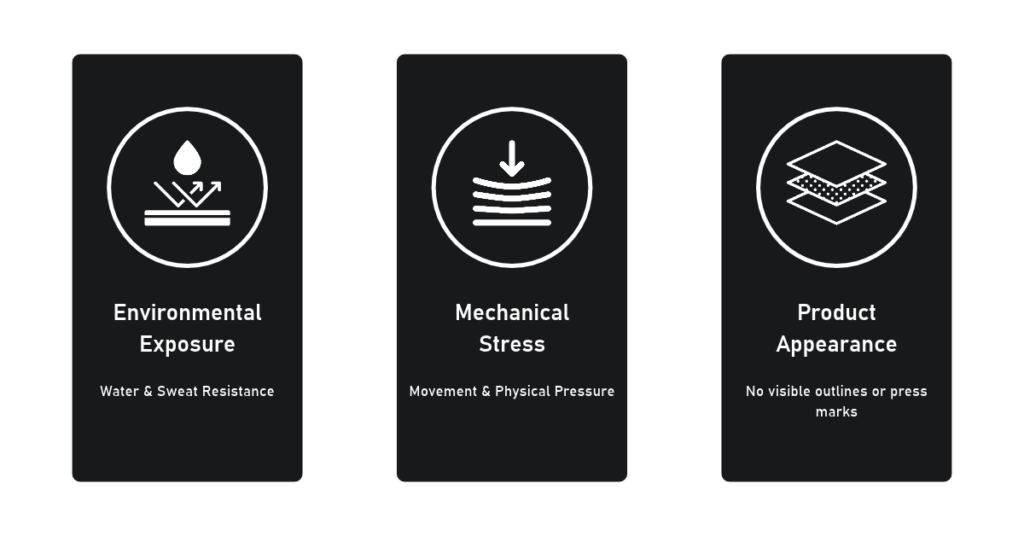
For wearable products, testing should cover three key areas:
- Environmental exposure: Electronic components must withstand water and sweat during use.
- Mechanical stress: Components must withstand repeated movement and physical pressure.
- Product appearance: Electronic components must fit inside soft materials without creating visible outlines or surface marks.
These areas can affect each other. For example, the integration method and bonding process can influence the finished product’s surface. Teams should consider all three areas when planning product tests.
When should testing begin during product development?
Testing requirements should be considered as early as possible because integration decisions can affect later development and manufacturing work. Some checks can begin during prototype builds, while most testing takes place during the Engineering Validation Test (EVT) stage.
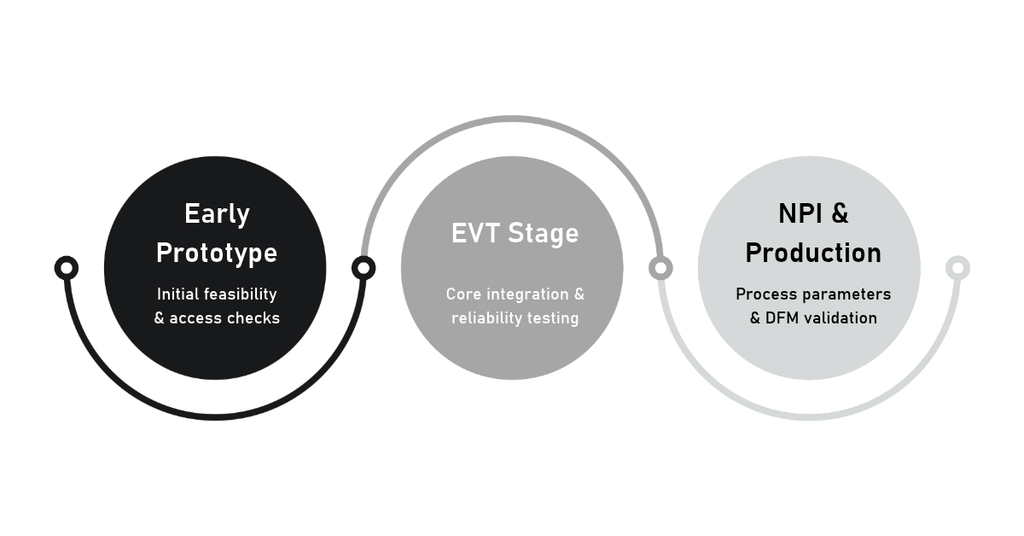
Early planning gives the team more time to identify potential issues and address them before production. It also helps teams understand which components need verification before they become difficult to access.
“Testing needs to be planned around the product and its development stage. Some checks can start with early prototypes, while other tests are more suitable once the design and integration approach are further developed,” explained Tamas.
Case Study: How did OSM resolve an electronic integration issue?
A wearable medical device project showed how a manufacturing process can affect both product appearance and integration quality. The device measured vital signs, including heart rate and blood oxygen levels. The customer required high-quality fabric with a smooth surface and no visible defects.
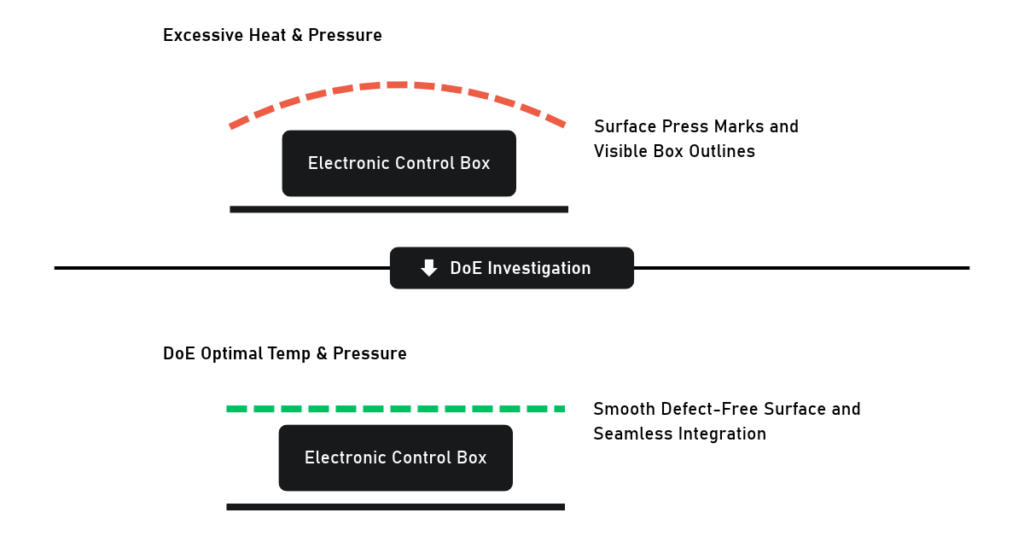
However, the embedded electronic control box created visible outlines through the outer fabric. Press marks also appeared on the surface after the soft component went through the heat press bonding process.
The issue was not limited to appearance. The electronic control box, which contained components such as a battery and sensors, could not be integrated seamlessly into the soft part. The team needed to understand why the process affected the finished surface before deciding how to correct it.
The team used Design of Experiments (DoE) to investigate the heat press bonding process. The analysis showed that excessive pressure and temperature caused the embedded electronics to show through the fabric. These settings also left visible marks on the surface.
The team tested different process settings using DoE to identify a suitable combination of temperature and pressure. The selected settings activated the adhesive and achieved proper bonding without overheating or applying excessive pressure.
The team then conducted trial production in significant quantities using different outer fabrics.
“A successful sample is only one part of the verification. We also need to confirm that the process can achieve the required bonding and surface quality across different materials,” said Tamas.
The case shows why identifying the cause matters. A visible defect may appear to be a material or design problem, but the actual cause may lie in the manufacturing process.
How do testing findings support future product development?
The team documented the findings during the New Product Introduction (NPI) phase. The lessons included suitable process parameters for similar foam and fabric heat press bonding applications. The team also considered these machine settings during prototype builds for future products with similar requirements.
Experience from previous projects can also inform new product design. Through Design for Manufacturability (DFM), OSM considers product structure, integration methods, material selection, and manufacturing requirements.
Bringing testing into the wider product development process
For products that combine engineered soft goods and electronics, quality depends on how well the complete product is designed, integrated, and manufactured. Individual component checks remain important, but they cannot replace testing that reflects the finished product and its intended use.
OSM brings Engineered Soft Goods R&D and Electronics Engineering expertise together with manufacturing capabilities. This allows our teams to address integration challenges across product development and manufacturing, from material selection and component integration to process validation and production.
Explore What’s Possible.
Get-in-TouchFrequently Asked Questions
Integrated product testing assesses how materials, electronic components, and manufacturing processes work together in a finished product. It considers the product’s intended use, not just the performance of individual components.
Testing should cover environmental exposure, mechanical stress, and product appearance. For wearable products, this includes exposure to water and sweat, repeated movement and physical pressure, and visible outlines or marks caused by embedded electronics.
Testing requirements should be considered early in product development. Some checks can begin during prototype builds, while most testing takes place during the Engineering Validation Test (EVT) stage.
DoE can help teams investigate how manufacturing settings affect product quality. In OSM’s wearable medical device project, the team used DoE to identify suitable heat press temperature and pressure settings, which helped achieve proper bonding without visible fabric marks.
About OSM Group
OSM Group was founded in Sweden in 2004. With strategically located production facilities in China and the Philippines and R&D in Stockholm, Hong Kong and China, we support leading brands worldwide with expertise-driven and reliable manufacturing solutions. Our vision is to deliver exceptional and sustainable products that strengthen our customers’ market competitiveness and long-term success. By combining Scandinavian heritage with a culture rooted in integrity, collaboration, and continuous improvement, we are committed to building enduring relationships based on trust and mutual growth.
Topics
Category
Discover More