What a Supplier Qualification Audit Cannot Show Until Production Starts
The problems that derail a product launch are rarely the ones you can see on audit day.
Most sourcing managers size up a factory by its equipment, floor space, and capacity. Those things matter — but they tell you almost nothing about whether a project will hold together once complexity climbs and the operational pressure comes on.
Multiple Production Runs. One Site. One Timeline.
A production floor can look immaculate on audit day. Then the launch schedules start to overlap. Raw materials arrive on different cycles. Engineering change orders keep landing late. Line priorities shift week to week. The floor that looked stable in the audit behaves very differently once several production runs are sharing it at once.
“The organization suffers extreme seasonality, especially when we have multiple product launches happening at the same time and at the same site,” said Salvatore Serio, Chief Operating Officer, OSM Group.
That is where consistency quietly slips — rarely in a single visible failure, more often in small drifts that surface only when a shipment runs late or a yield rate falls.

Product Specifications at Final Stage
The challenge gets harder when a product combines soft materials and electronics. Specifications often keep moving right up to launch — normal in development, where wear tests, field trials, and buyer feedback are all still shaping the final design.
That changes the operating condition entirely. Tooling, cut plans, line setup, and operator training can all be done — while certain component tolerances and final specifications are still in flux.
“We have many cases where specifications are still being defined even when the product is close to launch. Even if we are prepared, we often need to adjust and improve the process while production is already running,” Salvatore Serio explained.
So late changes aren’t the exception here. They’re part of how the product reaches its final form.
What separates a stable project from a troubled one isn’t whether changes happen — it’s whether the line and its process controls can absorb them without bleeding quality or slipping the schedule.
It’s why the same problem can play out very differently at two factories. The difference is how well each one manages late-stage change under pressure.

Root Cause Determines Recovery Time
Some issues snowball because teams react before they understand what actually went wrong. Others get contained fast, because the team pinpoints the exact failure, confirms the root cause, and verifies the fix before restarting production.
“Clear root cause analysis and corrective action verified by quality and technical teams determine whether an issue is solved quickly or turns into extended production delays,” Salvatore Serio said.
For sourcing teams, that reframes what scale even means. Scale isn’t just output volume. It’s the ability to hold process control, yield, and on-time delivery steady as projects get more complex, timelines overlap, and requirements keep moving.
What to Look for Before You Commit
Salvatore Serio points to several signals that matter during a supplier qualification audit — the ones that separate a floor that holds up from one that doesn’t:
- Company size — whether the organization has the depth to run overlapping launches without one starving another of people and machines.
- Management style and skills — whether the people running the floor can hold priorities steady when every project wants to be first.
- Experience with similar product complexity — whether they’ve absorbed late-stage change on comparable builds that combine soft materials and electronics.
- Visual management boards — whether status, priorities, and bottlenecks are visible in real time, or locked in one person’s head.
- Shop-floor process control — whether the line behaves the same way on a chaotic week as it does on audit day.
None of these is dramatic on a facility visit. But they are what decide whether the floor stays in control when material schedules slip, change orders land late, and two runs share a line at once. For brands whose products keep evolving right up to launch, these signals are the clearest read on how a manufacturer will behave once the pressure is real.
Built to Handle What Standard Manufacturing Cannot
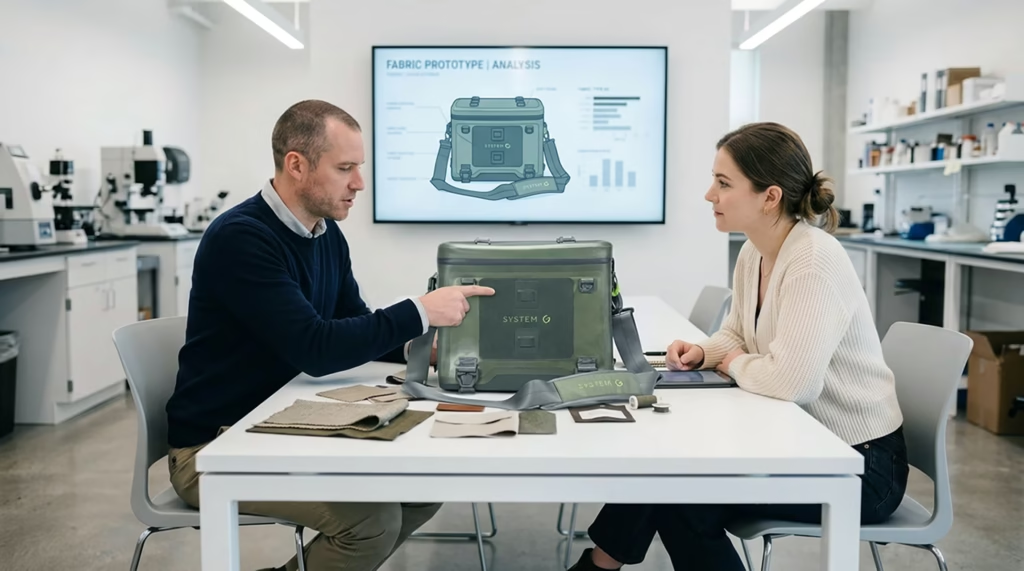
Products that integrate soft materials and electronics don’t follow standard manufacturing logic. Each discipline brings its own material requirements, process tolerances, and quality checkpoints. Managing them separately is the industry default. Managing them as a single development-and-manufacturing process is not.
OSM Group’s China facility images below cover the Electronics Engineering Lab, Production Lines, Chemical Testing, Finished Goods Testing, Packaging, and Warehouse. Each area is a checkpoint. Together, they show how quality is maintained at every stage, not only at the end.


That is where OSM Group operates. Founded in Sweden in 2004, with manufacturing facilities in China and the Philippines, supported by R&D teams in Stockholm, Hong Kong, and China. OSM Group is built around one integration capability that most manufacturers separate: bringing Engineered Soft Goods and Electronics together under one roof, from design through production. Not as two workstreams handed off between suppliers, but as a single integrated process where both disciplines inform each other at every stage.
We bring that integrated approach to a wide range of categories, including:
- Portable Audio e.g. Industrial and Consumer Headphones, ANC Headphones, Bluetooth Speakers, Radio Communication Systems
- Personal Protection e.g. Advanced Hearing Protection Solutions
- Hybrid solutions – engineered soft goods with integrated electronics e.g. diagnostic pads, tracking devices, laptop covers with integrated speakers, antenna
- Carry Solutions e.g. Travel Case, Carrying Laptop Bag, Backpack
- Specialised Sports Gear e.g. Weighted Training Vests, Hydration Packs and Functional Accessories
If your next product combines soft materials and electronics, come and see the floor for yourself. Contact us to arrange a facility visit — we’ll show you how our sites hold quality and schedule when complexity and pressure are at their peak, not just on a quiet audit day.
About OSM Group
OSM Group was founded in Sweden in 2004. With strategically located production facilities in China and the Philippines and R&D in Stockholm, Hong Kong and China, we support leading brands worldwide with expertise-driven and reliable manufacturing solutions. Our vision is to deliver exceptional and sustainable products that strengthen our customers’ market competitiveness and long-term success. By combining Scandinavian heritage with a culture rooted in integrity, collaboration, and continuous improvement, we are committed to building enduring relationships based on trust and mutual growth.
Topics
Category
Discover More
-
为什么 OSM Group 不只是普通的制造工厂
Manufacturing decisions can influence product success long before production begins. OSM Group combines integrated R&D, Design for Manufacturing, and global manufacturing to reduce risk and…
-
强化制造运营,更好地支持客户
Reliable manufacturing depends on experienced leadership, disciplined execution, and the ability to scale efficiently while maintaining consistent quality and delivery, strengthening our foundation for long-term…
-
从创意到量产
Hybrid products create risks when design, engineering and manufacturing decisions become disconnected. Discover how an integrated development path can identify issues earlier, control costs and…